
- Home
- Product application and solution
- Engineering Guide to Commercial Security Hardware
Engineering Guide to Commercial Security Hardware
Buyer's Guide to Barrel Locks
- Best Barrel Locks for Commercial Cabinets (Buyer’s Guide)
- OEM/ODM Barrel Locks: What Global Distributors Need to Know
- How Barrel Lock Security Levels Are Classified
- Disc vs. Pin Barrel Locks: Security Differences Explained
- Material Matters: Why Stainless-Steel Barrel Locks Offer Better Durability
- Keying Options for Barrel Locks: KA / KD / MK Systems Explained
- REAL Locks – Your Trusted Barrel Lock Supplier & OEM Manufacturer
Technical Overview for Commercial Cabinets, OEM/ODM Buyers, and Global Distributors
Barrel locks remain one of the most widely used mechanical locking solutions for commercial cabinets, lockers, industrial enclosures, and transportation equipment. Their compact size, stable operation, and customizable structures make them ideal for manufacturers and global distributors who require reliable, scalable, and secure locking systems.
This Buyer's Guide covers everything that procurement teams, OEM/ODM partners, and industry professionals need to know — from lock types and materials to security levels, keying systems, and international sourcing factors.
Best Barrel Locks for Commercial Cabinets (Buyer’s Guide)
When choosing a barrel lock for commercial cabinets—whether used in gyms, schools, industrial plants, hospitals, or offices—buyers must evaluate the following:
1.1 Security Level
Disc-detainers / Detained Disc
(Highest Security)
Often more complex and secure than Disc Tumblers. They use multiple independent rotating discs that must be precisely aligned for unlocking, offering extremely high resistance to picking and non-destructive entry methods.
Disc Tumblers
(Higher Security)
More resistant to picking and manipulation than standard pin tumblers. This design utilizes rotating discs rather than spring-loaded pins for elevated security performance.
Pin Tumblers
(Standard Security)
Cost-efficient and suitable for low- to medium-security applications. This is the most common lock type, relying on the alignment of vertical pins inside the cylinder.

1.2 Operating Environment
Choose based on durability requirements:
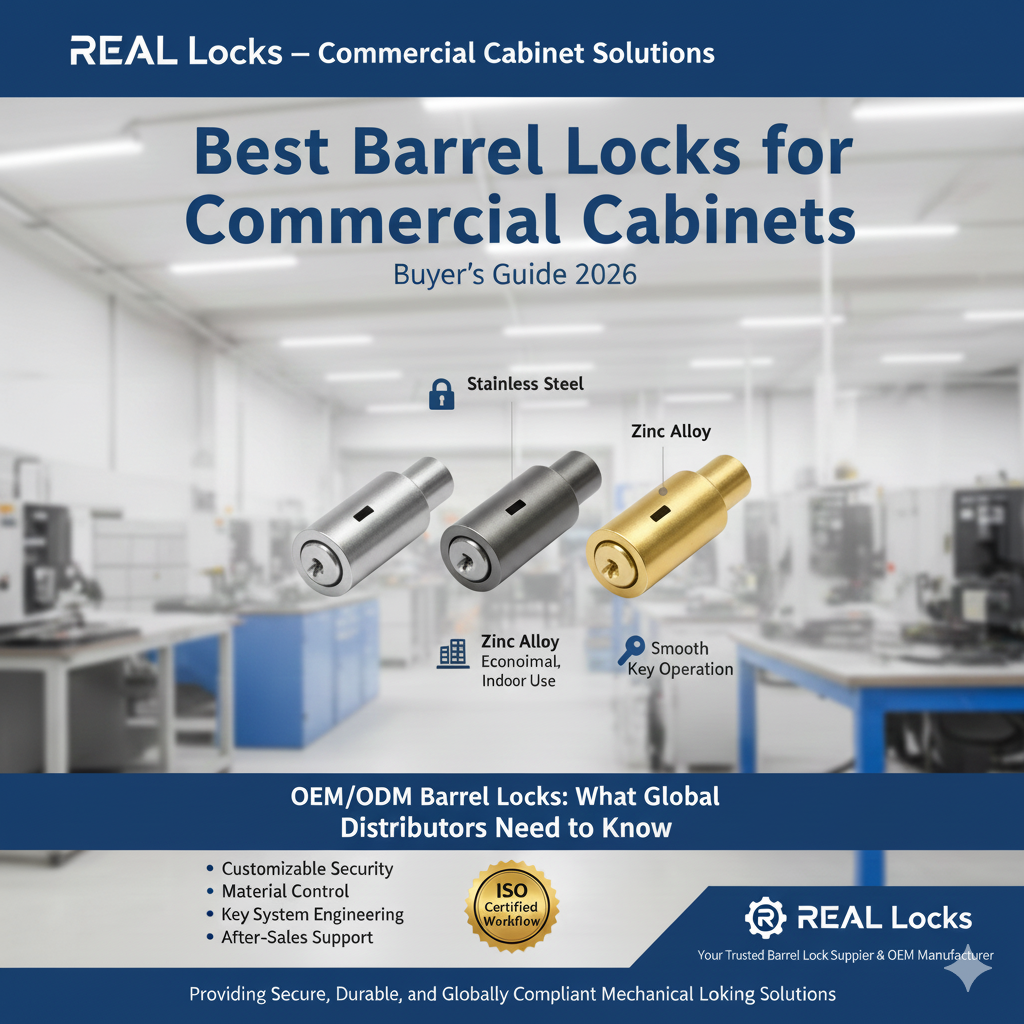
Stainless-steel body
- Corrosion-resistant
- Long lifespan
- Ideal for harsh or outdoor environments
Zinc alloy
- Economical solution
- Suitable for indoor cabinets
- Good balance of cost and performance
Brass cylinder
- Smooth key operation
- Excellent machinability
- Common in quality cabinet cylinders
1.3 Keying Systems
Depending on facility management needs:
KA (Keyed Alike)
Same key for multiple cabinets, ideal for simplified management.
Suitable for gyms, schools, and offices.
KD (Keyed Different)
Each cabinet has its own key for stronger individual security.
Common in retail stores & equipment storage rooms.
MK (Master Key)
One master key opens all locks in KA/KD groups.
Ideal for facility maintenance and supervisors.
1.4 Installation Compatibility
Commercial cabinet manufacturers look for:
- Standard cam compatibility
- Interchangeable barrel sizes
- Smooth integration into metal, plastic, or wood panels
Best choice:
A stainless-steel barrel lock with disc-detainer mechanism and MK-capable keying—balancing high security, durability, and operational convenience for commercial cabinet applications.
OEM/ODM Barrel Locks: What Global Distributors Need to Know
For distributors working with factories in Taiwan, China, or Southeast Asia, the following factors significantly impact product quality and consistency.
2.1 Customizable Security Levels
Leading OEM manufacturers can adjust:
- Number of discs or pins
- Cylinder length
- Key profile
- Anti-drill components
- Cam rotation angle
2.2 Material Control
Distributors should confirm:
- Stainless-steel grade
- Zinc alloy purity
- Brass content percentage
- Plating thickness for corrosion resistance
2.3 Key System Engineering
For large-scale tenders or cabinet brands, OEM factories must provide:
- Keying charts
- Master key hierarchy design
- Duplication control
- Serialization & key-code management
2.4 Production Consistency
Important indicators include:
- ISO-certified workflow
- Tolerance control in microns
- 100% key rotation testing
- Batch traceability
2.5 After-Sales Support
Global distributors' value:
- Replacement keys
- Swift sample production
- Stable annual supply capacity
How Barrel Lock Security Levels Are Classified (Technical Overview)
Security level classification typically considers:
3.1 Picking Resistance
- Disc mechanisms offer more complex manipulation paths
- Anti-pick wafers or high-precision cuts increase difficulty
3.2 Drilling Resistance
A higher security grade includes:
- Hardened steel front plates
- Anti-drill rods
- Stainless-steel construction
3.3 Key Control
Higher security = difficult key duplication
- Restricted keyway profiles
- Registered key distribution
- OEM-level code management
3.4 Structural Integrity
Factors include:
- Body material hardness
- Cylinder retaining system
- Cam strength under torque
Barrel locks are commonly labeled as:
- Standard security (basic pin tumbler)
- Medium security (disc tumbler + basic anti-drill)
- High security (advanced disc detainer + hardened components)
Disc vs. Pin Barrel Locks: Security Differences Explained
4.1 Disc Tumbler & Disc Detainer Advantages
✔ Harder to pick
✔ Stronger against torque attacks
✔ Ideal for high-security cabinets
✔ More durable in outdoor environments
4.2 Pin Tumbler Advantages
✔ Economical
✔ Stable performance
✔ Suitable for indoor cabinets & mass production
4.3 Which to Choose?
| Factor | Pin Tumbler (Standard) | Disc Tumbler (Higher) | Disc-detainer (Highest) |
|---|---|---|---|
| Typical Use | Interior doors, low-value storage, and most residential doors. | High-security padlocks, safe deposit boxes, vehicle locks. | Vending machines, heavy-duty industrial locks, critical infrastructure. |
| Security Level | Low to Medium | Medium to High | Very High to Maximum |
| Resistance to Picking | Easy/Moderate (Easily picked by novices or standard tools.) | Moderate/Difficult (Requires specialized tools and skill.) | Extremely Difficult (Requires specialized, often unique tools and high expertise.) |
| Resistance to Bumping | Low (Very susceptible to key bumping.) | High (Generally immune to bumping.) | Very High (Immune to bumping.) |
| Price | Low (Most affordable) | Medium | High (Most expensive) |
| Key Complexity | Simple, easy to duplicate. | More complex, often harder to duplicate. | Highly complex, keys are very difficult to duplicate. |
Material Matters: Why Stainless-Steel Barrel Locks Offer Better Durability
Material choice directly affects lifespan and performance.
5.1 Stainless Steel
- Corrosion-resistant
- Suitable for coastal, humid, chemical, or outdoor environments
- Longer lifespan
- Ideal for trucks, outdoor cabinets, and hospital equipment
5.2 Zinc Alloy
- Indoor use
- Affordable
- Wide plating options
5.3 Brass
- Smooth rotation
- Excellent machinability
- Common in mid-range cylinders
Best performance: Stainless-steel barrel locks with hardened components.
Keying Options for Barrel Locks: KA / KD / MK Systems Explained
6.1 Keyed Alike (KA)
- One key opens all assigned locks
- Suitable for gyms, schools, and offices
- Simplifies management
6.2 Keyed Different (KD)
- Every lock has its own key
- Better security
- Common in retail stores & equipment storage
6.3 Master Key (MK)
- Master key opens all KA/KD groups
- Ideal for facility maintenance teams
- Most flexible system for commercial installations
Large OEM orders typically combine KA + MK for the best balance.
REAL Locks – Your Trusted Barrel Lock Supplier & OEM Manufacturer
REAL specializes in:
- Disc & Pin barrel locks for commercial and industrial applications
- Stainless steel, brass, and customized barrel structures
- OEM/ODM development for global distributors
- Key-system engineering (KA/KD/MK)
- Precision manufacturing with international quality standards
With decades of engineering experience, REAL is committed to providing secure, durable, and globally compliant mechanical locking solutions.
Contact REAL LOCKS today to discuss bulk orders, OEM programs, or custom-manufactured key replacement components.